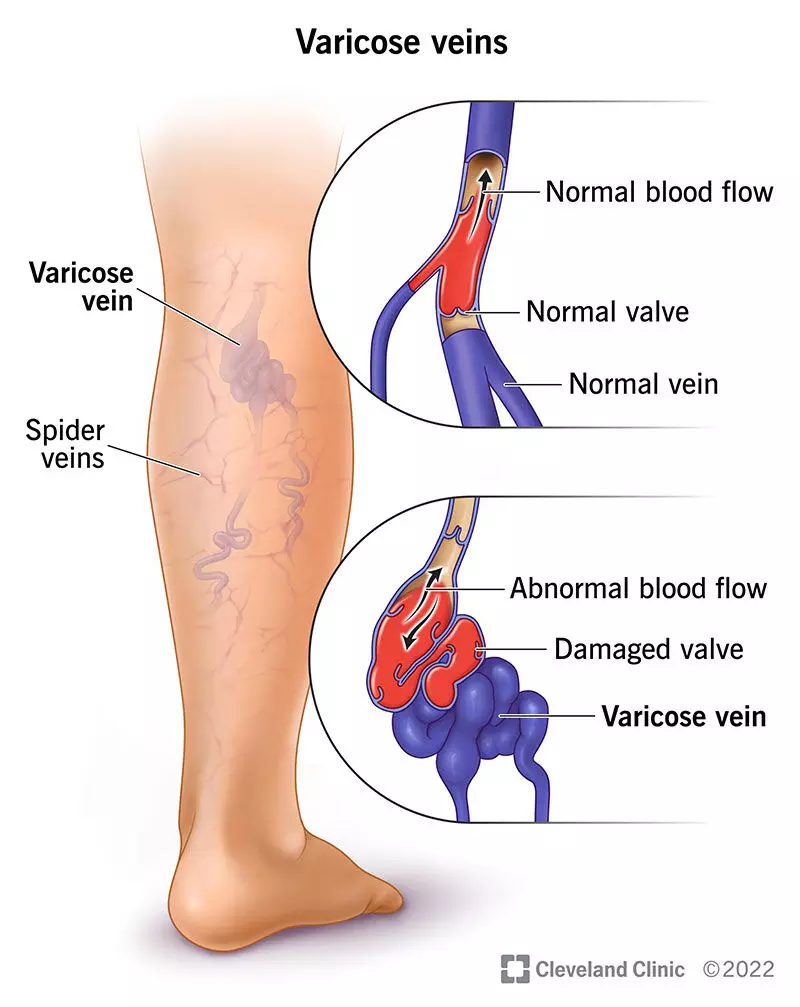
Varicose veins — the enlarged, dilated, twisted superficial veins in the legs — are not just a “cosmetic problem.” They actually indicate long-standing weakness of the vein walls and valves. Varicose veins are seen 2–3 times more commonly in women than in men.
What Is Bleeding in Varicose Veins?
Varicose veins are veins that appear enlarged, swollen, or twisted. They are visible just under the surface of the skin.
Normally, valves inside the veins push the blood upward toward the heart. However, when these valves become weak or damaged, the blood starts flowing backward.
This back-pressure causes the veins to stretch even more — and this condition can eventually lead to the serious complication of bleeding.
Why Is Bleeding from Varicose Veins Dangerous?
In healthy veins, the internal pressure is relatively low, But in varicose veins, the pressure is several times higher. As a result, even a small injury can trigger sudden and forceful bleeding.
In older adults, people with diabetes, or those with thin and fragile skin, this bleeding may become heavy, uncontrolled, and in some cases, life-threatening.
What Causes Bleeding in Varicose Veins?
Varicose veins can occasionally rupture and bleed even without major trauma. Bleeding can occur in two ways:
• External bleeding (on the skin surface):
A small cut, scratch, or minor injury can cause the vein to burst, leading to immediate and visible bleeding.
• Internal bleeding (under the skin):
A minor bump, fall, or slight impact may damage the vein internally. This results in bleeding beneath the skin, which later appears as dark blue patches, bruising, and swelling.
What Factors Increase the Risk of Bleeding in Varicose Veins?
Several physical conditions and lifestyle factors can significantly increase the risk of bleeding in varicose veins, such as:
• Thinning and weakening of the vein walls
• Occupations that require prolonged standing (teachers, shopkeepers, hairdressers, etc.)
• Pregnancy or recent childbirth
• Obesity
• Hormonal pills (birth control)
• Previous deep vein thrombosis (DVT)
• Family history
How to Recognize the Symptoms?
If bleeding is occurring beneath the skin, the patient may notice the following signs:
• A spreading blue or purple discoloration on the skin
• Heaviness, burning, cramps, and fatigue in the legs
• Pain worsening after prolonged standing
• Dry, irritated skin
• Feeling dizzy or faint (occasionally)
• If the skin becomes thin and shiny — it is considered a “pre-bleeding warning sign.”
How Is the Condition Diagnosed?
The doctor first evaluates the patient’s symptoms, medical history, and the visible appearance of the leg veins. However, to determine the severity and the exact level of the problem, certain specialized tests are performed:
• Venous Clinical Examination – A detailed assessment of the leg veins, swelling, and skin changes.
• Venous Doppler Ultrasound – The primary test to evaluate blood flow in the veins and the functioning of the valves.
• CEAP Classification – Used to “stage” the disease and plan the most appropriate treatment.
After these evaluations, it becomes clear whether the problem is limited to the superficial veins or if the deep venous system or perforator veins are also involved. This helps in deciding the right line of treatment.
What Is the Treatment?
The treatment of varicose veins focuses on two key goals:
- Preventing immediate harm, and
- Reducing venous pressure over the long term to stop progression and complications such as bleeding.
• If bleeding occurs, apply immediate pressure with a clean cloth or bandage.
• Wear compression stockings to reduce swelling and support the veins.
• Elevate the legs above heart level several times a day — this helps lower venous pressure.
• Avoid smoking and alcohol, as they impair blood circulation.
• Maintain a healthy body weight.
• Do regular walking and ankle-pump exercises — these improve the calf muscle pump function.
• Keep the skin moisturized to prevent dryness and thinning.
If a cut occurs on a varicose vein and bleeding starts, immediate pressure must be applied.
2) Medical Treatments Provided by a Doctor
When conservative measures are not enough, or when the veins are significantly damaged, doctors may recommend minimally invasive techniques such as:
• Vein Stripping
• Laser Ablation
• Radiofrequency Closure (RFA)
• Sclerotherapy
All of these procedures work by closing or eliminating the faulty vein so that the backward flow of blood can be stopped.
What Precautions Are Necessary?
Patients with varicose veins should adopt a few simple changes in their daily habits to reduce pressure on the veins and protect the skin:
• Avoid standing for long periods — take breaks, walk around, or sit and rest your legs intermittently.
• Avoid high heels, tight clothing, or restrictive garments — these impede proper blood flow.
• Be careful while shaving, waxing, or gardening — the veins lie close to the surface, increasing the risk of injury.
• Inspect the skin on your legs daily — look for dryness, cuts, scratches, discoloration, or new patches, and note them promptly.
These small precautions can significantly reduce future risks and help prevent complications.
When Should You Seek Immediate Medical Attention?
If you notice any of the following warning signs in the area affected by varicose veins, do not ignore them — they may indicate a developing complication:
• Repeated severe pain, warmth, or redness in the area
• New swelling in the legs or the appearance of a new wound
• An existing wound increasing in size or developing foul-smelling yellow discharge
• Persistent or recurrent high fever
In such situations, it is essential to consult a doctor without delay.
When Should You Consider the Condition Serious? (Medical Emergency)
If any of the following signs appear, it is considered a medical emergency, and the patient should be taken to a hospital immediately:
• The leg or foot starts turning blue or black
• Difficulty in breathing or chest pain
• Sudden, severe, unbearable pain in the legs
• Bleeding that does not stop
In these situations, delaying treatment can be dangerous — urgent emergency medical care is essential.
Awareness Is Protection
Varicose veins are not just a “cosmetic issue” but a neglected circulatory disorder that can gradually become serious.
If ignored, a simple swelling can progress to severe bleeding, ulcers, infections, and even medical emergencies. Therefore, do not overlook the symptoms. Seek specialist advice on time, undergo regular monitoring, and adopt necessary lifestyle changes.
Awareness, early detection, and timely treatment are the safest ways to prevent future complications from varicose veins.
National Institute for Health and Care Excellence (NICE), UK.
Varicose veins: diagnosis and management (Clinical guideline CG168).
https://www.nice.org.uk/guidance/cg168
Society for Vascular Surgery & American Venous Forum.
The management of chronic venous disease guidelines.
Journal of Vascular Surgery: Venous and Lymphatic Disorders. 2022 Update.
American Venous Forum (AVF).
Bleeding from Varicose Veins: risks and emergency advice.
(AVF Patient Education Factsheet)
Klabunde RE. Cardiovascular Physiology Concepts — Venous Pressure and Venous Blood Flow.
Lippincott Williams & Wilkins.
International Union of Phlebology (UIP).
CEAP Classification of Chronic Venous Disorders (2020 Revision).