

14-Month-Old Baby Undergoes India’s Youngest POEM
A 14-month-old severely underweight infant suffering from rare Achalasia Cardia was successfully treated with India’s youngest Per Oral Endoscopic Myotomy.
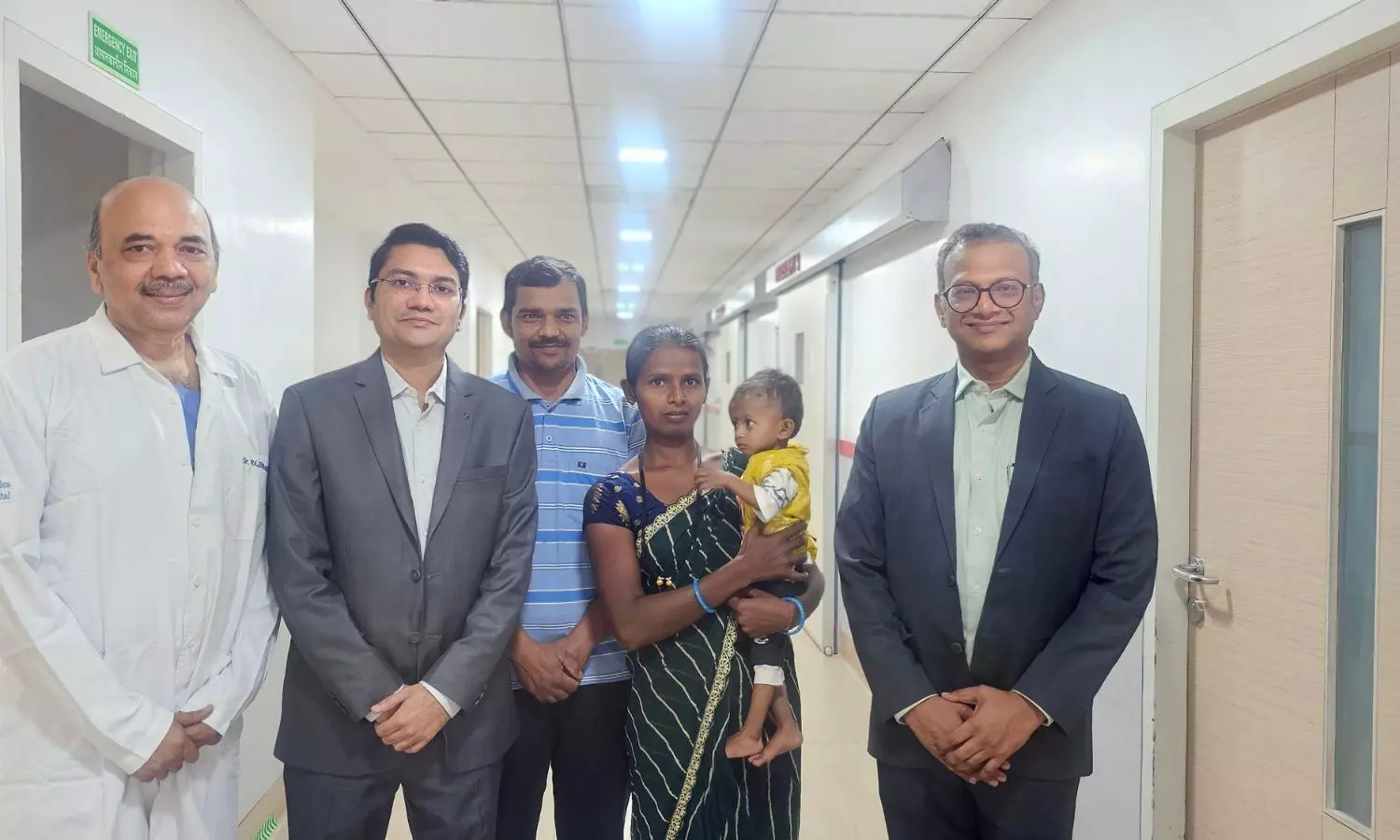
A 14-month-old severely underweight child, who was unable to swallow solid and liquid food due to a tight blockage at the junction of the food pipe and stomach, has received a new lease of life after undergoing a cutting-edge Per Oral Endoscopic Myotomy (POEM) procedure at Gleneagles Hospital, Mumbai. The child, weighing just 5.9 kg, was suffering from a rare condition known as Achalasia Cardia, which had led to persistent vomiting, repeated pneumonia, poor growth, and severe malnutrition. The complex, scarless endoscopic procedure was successfully performed by a multidisciplinary team of specialists involving Dr Vibhor Borkar, Dr Shankar Zanvar, and Dr Rajan Daftari, marking a major milestone in paediatric gastroenterology in India.
The child, Neeraj Balu Kavar, from Chinchore village in Nashik district, Maharashtra, appeared healthy in his early months and was able to consume milk normally. However, the family’s happiness soon turned into worry when, after nine months of age, Neeraj began vomiting repeatedly every time solid foods such as khichdi were introduced. What initially seemed like a feeding issue soon became a daily struggle.
Over the next three months, his condition steadily worsened. Neeraj started losing weight rapidly, became weak, and suffered from repeated chest infections, including three episodes of pneumonia. Watching their child fail to grow and fall sick again and again left the family distressed and helpless.
Despite consulting several local clinics, the cause of Neeraj’s suffering remained unclear. With no answers and their child’s health deteriorating, the family was finally referred to Dr Vibhor Borkar, prompting them to travel from Nashik to Mumbai in search of hope. Upon reaching Gleneagles Hospital, Parel, Mumbai, on the early 9th December, doctors carried out detailed investigations, including a CT scan and endoscopy.
The tests revealed a critical and rare condition. Neeraj’s food pipe was massively dilated, and the valve at the junction of the food pipe and stomach was abnormally tight and closed, preventing food from passing into the stomach. This confirmed the diagnosis of Achalasia Cardia, a rare disorder that explained months of vomiting, infections, and poor growth, and finally gave the family a clear answer and a path toward recovery.
Given the child’s extremely low weight and fragile condition, conventional options like balloon dilation or open surgery were not suitable. The team decided to perform POEM, a minimally invasive endoscopic procedure, making Neeraj India’s youngest and smallest child to undergo this treatment.
Dr Vibhor Borkar, Director - Paediatric Gastroenterologist and Hepatologist, said, “This child, Neeraj, had been suffering from recurrent vomiting and repeated episodes of pneumonia since early infancy. Because of these symptoms, he was initially suspected of having reflux disease or even a heart-related problem, which is common in such young children.
However, when he came to us, and we evaluated him in detail, we realised that the root cause of his illness was actually in the food pipe. Endoscopy showed that his oesophagus was massively dilated, and the valve at the junction between the food pipe and the stomach was extremely tight and not opening at all. This condition is known as Achalasia Cardia. Normally, when we swallow food, the food pipe pushes it into the stomach, and the valve opens and closes in a coordinated manner.
In Achalasia Cardia, this coordination is lost. The valve remains closed, food accumulates in the food pipe, and because of this, the child keeps vomiting. In many cases, small amounts of food can enter the windpipe and lungs, leading to aspiration pneumonia. This repeated illness and vomiting severely affect nutrition, growth, and overall development."
Dr Shankar Zanwar, Sr consultant Gastroenterologist, Gleneagles Hospital, Mumbai, said, “Per-oral endoscopic myotomy, or POEM, is a unique procedure in which we work within the layers of the food pipe and carefully cut the muscles that have become abnormally tight at the junction between the food pipe and the stomach. In this condition, the valve remains so tightly closed that food cannot pass into the stomach and instead comes back into the food pipe.
By opening this muscle endoscopically, we allow food to pass down normally, without any external cuts or scars. POEM is well-established in adults, and we have successfully treated a large number of such patients who are usually discharged within a day, avoiding major surgeries that were done earlier. Balloon dilation, which is another treatment option, has a high recurrence rate of nearly 40 per cent, and in a child weighing just 5.9 kg, balloons of an appropriate size are not even available.
Dr Shankar Zanwar further added, “In this particular case, we had to modify our entire approach. Adult endoscopes are not designed for such small infants, so we adapted a bronchoscope normally used for lung procedures and carefully used it to create layers within the food pipe and perform the myotomy. What makes this case truly exceptional is that this is the youngest child in India to undergo the POEM procedure, and based on published medical literature, the second youngest in the world. While an 11-month-old child from China has been reported earlier, by weight, this child is possibly the smallest ever treated with POEM. The procedure is minimally invasive, avoids major scars, and allows faster recovery. Although most patients can start eating within three to four days, we waited slightly longer in this child due to his severe malnutrition to ensure complete healing. He has now started feeding well, there is no regurgitation, and he can swallow comfortably. Seeing such a positive outcome in such a fragile child is extremely rewarding and shows what advanced endoscopic care can achieve.”
Dr Vibhor Borkar further added, “Neeraj was diagnosed at 14 months of age, but he had started showing symptoms as early as five to six months. Achalasia Cardia is an extremely rare condition in children, affecting about one in five lakh infants, and its exact cause is usually unknown. It is often congenital, present from birth, but becomes noticeable only as the child grows and starts eating solid foods. Because of its rarity, there is often a long delay between symptoms and diagnosis. In older children or adults, balloon dilation is sometimes an option, but this is not possible in such a small, fragile child. Surgery is another option, but it is invasive, leaves scars, and requires a longer recovery period. In Neeraj’s case, we chose a minimally invasive endoscopic treatment called the POEM procedure, where everything is done internally without any external cuts or scars and is extremely safe.”
Given his severe malnutrition, dehydration, and electrolyte imbalance, he was a high-risk child and needed careful hospital care. After the procedure, we kept him nil by mouth initially to allow proper healing and supported him with tube feeding to ensure adequate nutrition, as malnourished children often do not eat enough on their own. Today, he is much better hydrated, nutritionally stable, and able to swallow food without vomiting. Early diagnosis and timely intervention are crucial, because otherwise such children suffer from failure to thrive and are at very high risk.
Dr Rajan Daftari, Consultant Anaesthesiologist and Chief of Endoscopy Department, Gleneagles Hospital, Mumbai, said, “From an anaesthesia point of view, this was one of the most demanding cases. In such small babies, even passing an endoscope can compress the airway and affect breathing. Drug dosages are extremely precise with no margin for error.”
The child’s mother, Pramila Kavar, said, “For months, we watched our child suffer. He could not eat, kept vomiting, and was falling sick repeatedly. No one could tell us what was wrong. Today, seeing him eat properly and slowly gain strength feels like a miracle. We are forever grateful to the doctors who gave our child a second chance at life.”
“At Gleneagles Hospital, we are committed to pushing boundaries to save lives, even in the most complex and rare cases. This successful POEM procedure in a 14-month-old child reflects our strong multidisciplinary approach, advanced infrastructure, and unwavering focus on patient safety. We are proud to offer world-class, minimally invasive treatments in India and remain dedicated to bringing hope to families who have exhausted all other options,” concluded Dr Bipin Chevale, CEO, Gleneagles Hospital Mumbai.

Kanchan Chaurasiya joined Medical Dialogues in 2025 as a Media and Marketing Coordinator. She holds a Bachelor's degree in Arts from Delhi University and has completed certifications in digital marketing. With a strong interest in health news, content creation, hospital updates, and emerging trends, Kanchan manages social media, news coverage, and public relations activities. She coordinates media outreach, creates press releases, promotes healthcare professionals and institutions, and supports health awareness campaigns to ensure accurate, engaging, and timely communication for the medical community and the public.