

Largest HPV Vaccination by Pratishruti Trust of Assam
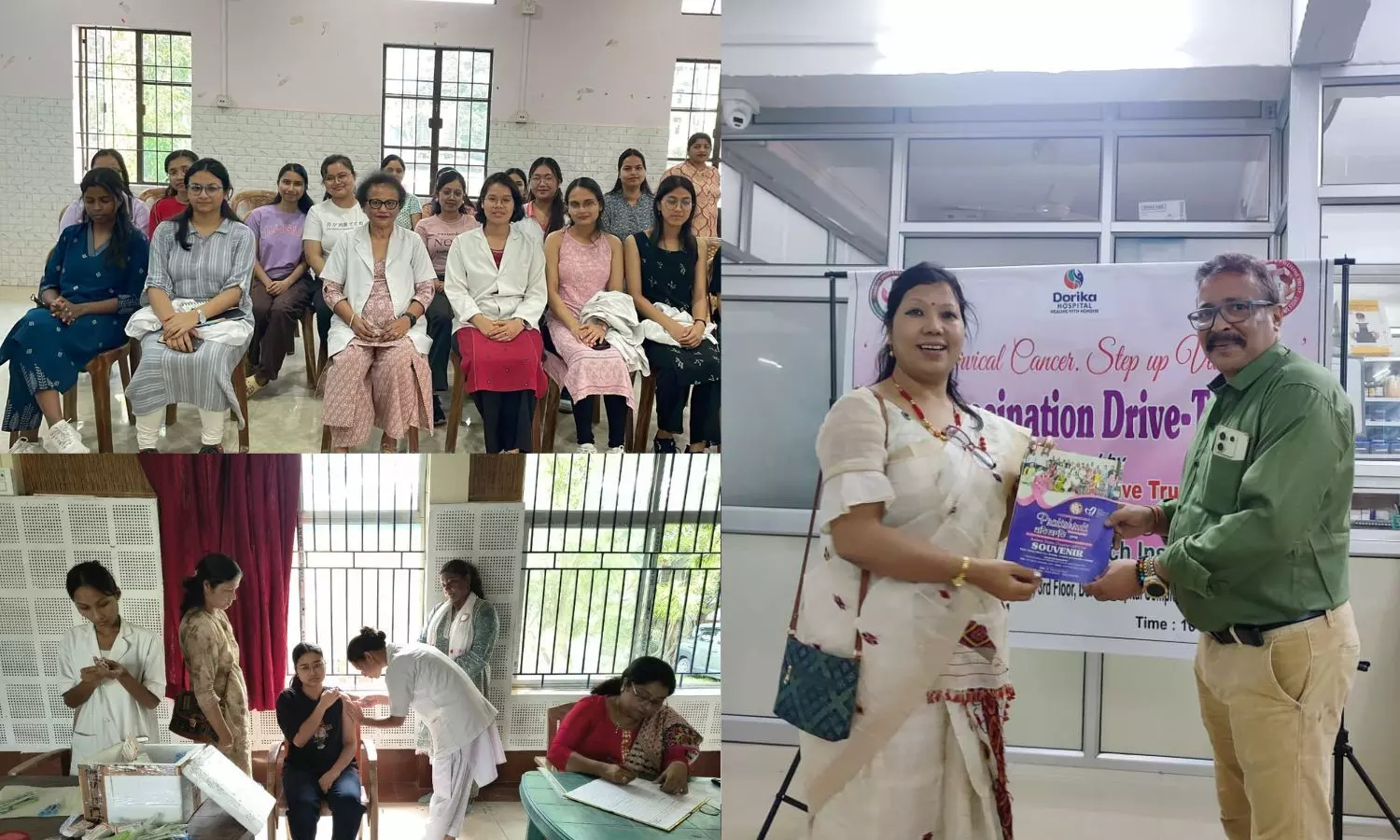
Cervical cancer is the second most common cancer of females, which takesthe life of one woman every 8 minutes in India. In 99% cases of cervical cancer, the proven cause is high-risk Human papilloma virus subtypes such as HPV 16, 18, etc., in cases of virus infections for a long period of time. However, it causes some other cancers in men and women, although the burden is not as high as cervical cancer.
Dr Gayatri Gogoi, a well-known cancer Researcher and Professor, assisted by Sadiqah kouser an MBBS student of AMCH Dibrugarh, conducted a survey on HPV Vaccination awareness and willingness among 160 students of Upper Assam at the beginning of 2025. The survey was to assess awareness, hesitancy, and willingness toward HPV vaccination among students at high schools and the college level. The study aimed to highlight the need for proactive and large-scale vaccination initiatives to prevent HPV-related diseases, including cervical cancer.
The survey, which gathered responses from various participants, revealed that fewer than 1% of respondents had taken the HPV vaccine. When asked who were aware about vaccine could prevent still why they did not get it, then 60.1% stated they had not had the opportunity to do so, and 39.9% unaware of the vaccine altogether.
While further evaluating their concern and barriers majority of them cited high cost as a major barrier, while a smaller percentage expressed concerns about side effects or uncertainty about its necessity.
It was further asked about their interest in subsidised vaccination. Encouringly, 88.1% of unvaccinated respondents showed interest in receiving the HPV vaccine if available at a subsidised rate.
The majority of respondents expressed strong support for including the HPV vaccine in routine immunisation programs. These findings emphasise the urgent need for greater awareness campaigns, accessibility initiatives, and government-supported vaccination drives to ensure widespread protection against HPV-related diseases.
With the above findings of the survey, Dr Gayatri Gogoi, a strong advocate of community-driven cancer awareness campaigns of North East India, designed and conceptualised a project to initiate in consultation with Pratishruti Cancer and Palliative Trust. The objective of the project was to create wide-scale awareness about the need for HPV vaccination to prevent cervical cancer in particular, as well as HPV related other tumours. At the same time, the project planned to ensure the availability of vaccines at half the price than hospital setting.
The question-Answers sessions were done after every batch of HPV vaccination beneficiaries enrolled before proceeding to vaccination. The first drive was flagged off at Dibrugarh by Pratishruti with the Indian Medical Association Dibrugarh and the Federation of Obstetrics and Gynaecological Society of India, Assam, on 6th March at the Dibrugarh IMA house.
Then it continues to carry out many vaccination drives in Guwahati with Nemcare Hospital, Dhemaji, Jorhat at Satyam Hospital, Sibsagar and Diphu at DMCH, Nalbari at IHA House, Tezpur at Sankara Hospital and Research Centre, Nagaon at SIMS Hospital, Morigaon at Maternity Multispeciality Hospital, Tinsukia with Rotary Club for the last 7 months, and now it has reached upto 3000 vaccines. Dr Rina Ahmed, Dr Gourangie Gogoi, Dr Sikha Sarma, Dr Vandana Gupta, Dr Bihari Agarwal, Dr Ajanta Deuri, Dr Rakhi Shyam, Dr Malabika Saikia, Dr Jyotika Boidya, Dr Anjan Rajkonwar, etc., are a few of them among many leading the drive. Ms Manjula Agarwal, Ms Panna Bharali, Jayshree Gogoi, Sewali Chetia, Utpala Shrutikar, Shabina Yasmin, Deepika bordoloi Asmita Kalita, Mouchumi Gogoi, and Karabi Hazarika are some of them spearheading as the coordinators of various districts.
As Cervavac, a quadrivalent vaccine, is now available after Serum Institute of India has started producing in much lower cost, giving a significant cost effectiveness than ever before, allowing easy affordability. After the Indian indigenous CERVAVAC HPV vaccine was approved by the Drug Controller General of India in 2022, the price of vaccines is affordable for a greater population. The 9 to 14 year age group requires 2 vaccines in a gap of 6 months, and the 15 to 26 year age group requires 3 doses in a 0-day, 2nd-month and 6th-month schedule.
As per the record, this is the largest HPV vaccination coverage by a non-profit making organisation in India in the shortest period of time of 7 months. Pratishruti has been giving free vaccination to daughters whose mothers are affected by cervical cancer, as well as selected economically weaker, other cancer-affected poor families.
It must be emphasised that there are 100s of cancer types, but not all cancers can be prevented; however, cervical cancer has an answer to prevent by HPV Vaccines. It can also be prevented by screening tests for early detection, which should be done in a periodic interval. Many hospitals and doctors, health care workers and volunteers from different districts of Assam are involved in this mission.
Nagaon District Administration adopted a significant move to prioritise HPV vaccination programs, enhance affordability, and educate the public on the benefits of HPV vaccination among public. Mr Debasish Sarma is known for his extraordinary effort for cancer related together with Pratishruti and Nagaon Medical College Hospital. Cancer impact was a point of discussion, and the public were sensitized in the 15th August parade ground while vaccinating free, sponsored by Deepsikha Foundation and subsidised vaccines were also provided to 100 beneficiaries.
It should also be stated that HPV vaccines are being given by practitioners in a few hospitals in Assam. However, it will not be able to cover the eligible age groups till the government integrates into universal immunisation.
It is noteworthy to mention that MLA of Gohpur constituency of Assam, Mr Utpal Borah, has been highly motivated to organise free vaccination of 40 girls of his constituency on 28th December.
India announced HPV vaccination for girls as a national priority in the 2024 Union Budget, with a phased, school-based rollout targeting 9–14-year-olds. This is critical as India accounts for nearly 20% of global cervical cancer cases and would need to vaccinate ~68 million girls initially.
WHO’s 2022 recommendation for a single-dose schedule is highly relevant for India. Strong evidence, including a large Indian cohort followed for 15 years, shows that a single dose provides vaccine efficacy (~95%) and long-term antibody persistence comparable to two or three doses. Modelling suggests that a single-dose strategy could avert nearly one million cervical cancer cases and achieve elimination targets more cost-effectively than two doses. Strong evidence, including long-term Indian data, shows that a single-dose HPV vaccine provides protection comparable to two or three doses. A single-dose strategy would be more affordable, simpler to deliver, and could prevent nearly one million cervical cancer cases. With the launch of the indigenous Cervavac vaccine, India should adopt a pragmatic approach—such as extended dosing intervals and rapid evaluation of a single-dose schedule—to accelerate cervical cancer elimination and maximise public health impact.
This exemplary initiative by Pratishruti under the visionary leadership of Dr Gogoi has disseminated widespread movement across Assam, enabling other partners to continue vaccination. Pratishruti Cancer and Palliative Trust is an organization who serve in the field of cancer and Palliative care. It will keep one step ahead of the target set by the World Health Organisation.
Deshbandhu Singh is the Senior Managing Editor at Medical Dialogues and Health Dialogues with about three decades of experience in both print and digital journalism. Previously, he has held editorial leadership roles at NDTV (Head of Digital Content Strategy and Senior Executive Editor), India Today Group Digital, Hindustan Times, Times Internet, and Sahara India. He is known for his expertise in digital content strategy, newsroom operations, and the launch of leading web and mobile platforms in Indian media.